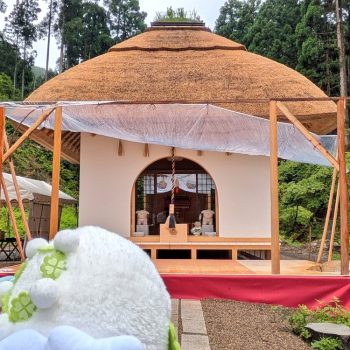
Welcome to the breathtaking Sayama Forest Chapel.
Welcome to the breathtaking Sayama Forest Chapel.

We’ve never had much of a green thumb but maybe we’ll have more luck with an air thumb? A small Japanese company based out of Kyushu has created a fun, poetic twist on indoor gardening. By utilizing the opposing forces of magnetic energy they’ve created a levitating plant called Air Bonsai.

The rise in popularity of emoji in the West has followed the same course as how Ernest Hemingway describes a man going broke: “gradually then suddenly.” Now, emoji seems to be everywhere from Hollywood movie billboards to, well, the Oxford Dictionary. But for artist Shinji Murakami the world is just catching up to his love affair with the pictograms originally developed by Japanese mobile phone operators in the late 90s.
Inspired by the ancient yet versatile 8-bit technology, Murakami has been creating works harken back to Dragon Quest, Zelda and other video games of his childhood. And now he’s presenting a series of new works during a major solo exhibition in New York.

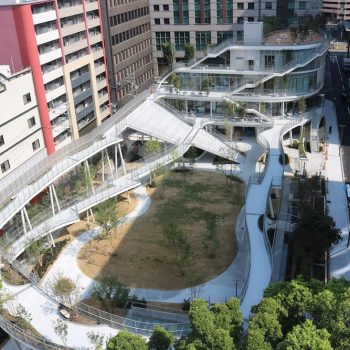
the new 599 Museum is named after the elevation of Mt. Takao in the outskirts of Tokyo
Sick of the hustle and bustle of Tokyo and itching to get away for a day?
Then I’ve got the perfect solution for you. Merely an hour’s ride from metropolitan Tokyo, in Hachiōji, there is a mountain resplendent with scenic beauty, hiking trails, and a buddhist temple. Mt. Takao, whose peak reaches 599 meters, (1,965 ft) high, is a protected environmental zone nestled within a quasi-national park. Like Mt. Fuji, its scenic beauty earned it an impressive 3 gold stars from the famous Michelin Guide.
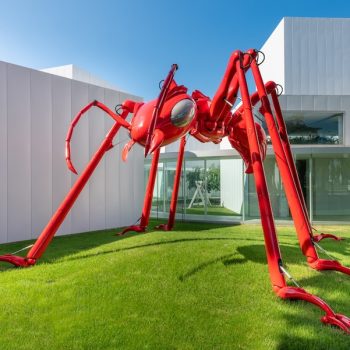
Visitors curious to learn more about all the animals and bugs that they come across during their hiking expeditions up Mt. Takao can satisfy their curiosity at the foot of the mountain. There, the newly opened Takao 599 Museum welcomes visitors with an exciting array of exhibitions, as well as a well-pruned lawn complete with avant-garde benches, a terrace, and a cafe.

Tokyo is an infinitely photogenic city. And there’s no shortage of photographers capturing its vibrant landscape. But local resident and photography aficionado Masashi Wakui has a unique, surreal style of capturing Tokyo by night and making it look like an animated still from Akira or a Ghibli film.

unless otherwise noted, all photos courtesy Satoru Hirota Architects
Although there are no clear records, the Tsunyuji Temple in a Northeastern part of Tokyo was thought to have been originally built in the early Edo period sometime between 1624 – 1645. It belongs to the Otani school of Jodo Shinshu Buddhism and has been a spiritual boon to the neighborhood since any resident can remember. But the last time it had any major work done was in 1949, after it had to be rebuilt from damage during WWII.

unless otherwise noted, all photos by Craig Mod | used with permission
120 years ago it was an indoor greenhouse for growing koji seeds, a key ingredient in sake as well as miso and soy sauce. Now, thanks to a small group of friends, it’s been beautifully renovated into the Kyoto Moyashi House. Whether you’re looking for an authentic place to stay or to host an off-site seminar, the large Machiya can serve as a unique backdrop.

all photos by Andreas Kofler
One morning, early last October in Tokyo, Andreas Kofler awoke to find something peculiar. Working ever so quietly and efficiently, overnight workers had given Shibuya’s emblematic Aoyama Dori a new layer of asphalt. And in doing so, the road’s primary markings – cross walks, lane dividers, arrows – had all been replaced by minimalist, provisional “sketches.”

Monopoly: Traditional Japanese Arts & Crafts Edition
The board game Monopoly, released in over 200 countries, has proved so popular that the exhaustive list of variations is just that: exhaustive. But now we can add one more esoteric variation for those obsessed with traditional Japanese craft work. Yes, it’s the “Traditional Japanese Arts & Crafts Edition.”
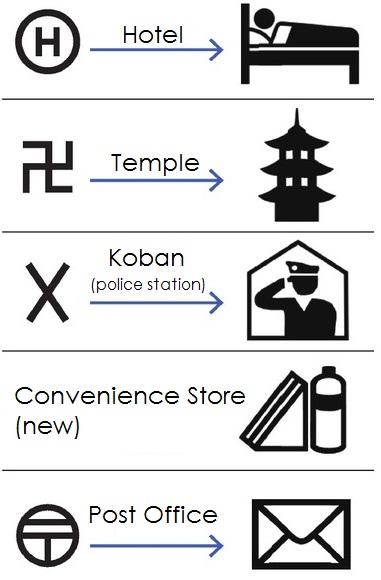
image courtesy the Asahi. Translated by Spoon & Tamago
When we moved to Japan in the early 80s my dad, a Jewish New Yorker from the Bronx, quickly realized that he had made a terrible mistake. “We’re surrounded by Nazi’s,” he proclaimed, wide-eyed, as we all stared at a map of our local neighborhood in Koenji. He was, of course, looking at the manji symbol (卍), a reverse swastika that could understandably be mistaken for the symbol of Nazi Germany, instead of its intended representation of Buddhist temples.
Now, over 30 years later, Japan is taking steps to update and redesign some of its more esoteric pictograms in a move intended to make the country more foreigner-friendly.


 OrySnack: The Bar Where Bartenders Work From Home
 Winners of Japan’s 2027 Packaging Design Awards
 Tokyo is Gearing Up for an Art-Filled Fall. And the Entire City is Here for It
 Japanese Aquarium Drops 2026 Version of Flowchart Illustrating Their Penguin Relationships. This Year There’s an English Version.
 Kirie Artist Carves Playful Narratives Into Tree Leaves