
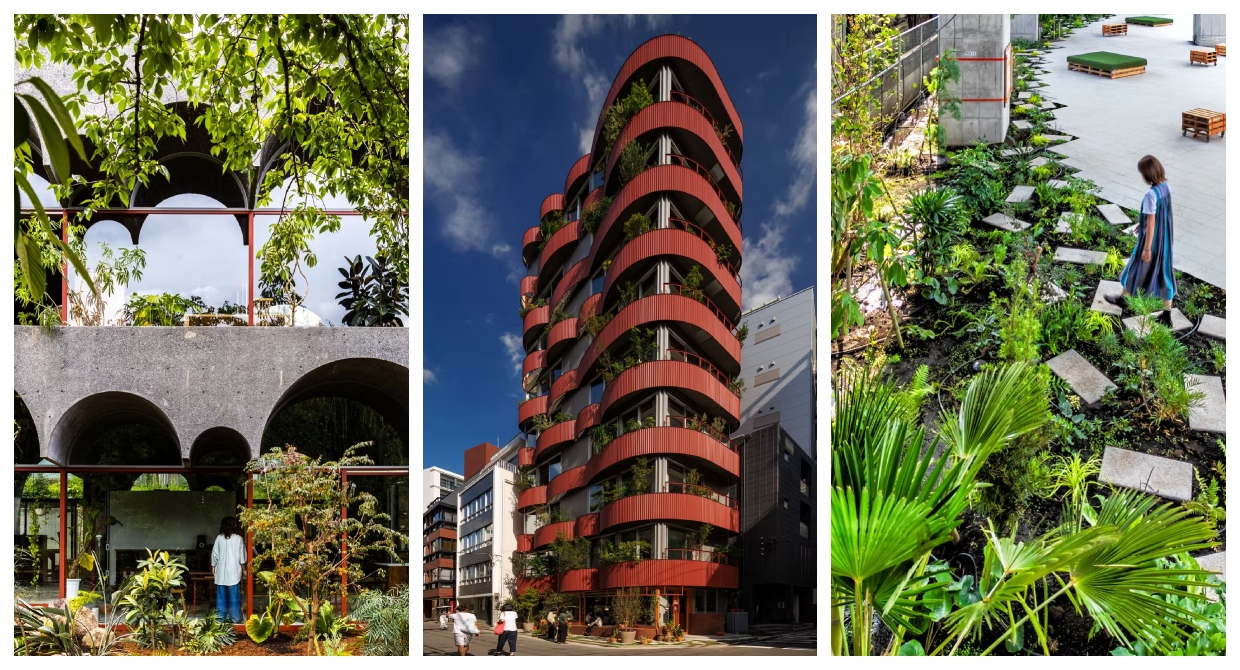
Japanese architect Kiyo Takeda belongs to a new generation of designers challenging the long-held notion that architecture should impose order on nature. Instead, his work embraces unpredictability, creating buildings that evolve over time as plants, weather, and the surrounding ecosystem become active collaborators.
After studying at the University of East London, Takada joined Kengo Kuma & Associates in 2008 where he worked for over a decade. Takeda established Kiyo Takeda Architects in Tokyo in 2019. His practice has quickly gained recognition for projects that blur the boundaries between architecture, landscape, and ecology.
At the heart of Takeda’s philosophy is the belief that buildings should not merely coexist with nature but actively participate in it. Rather than treating landscaping as an accessory, his projects often integrate soil, vegetation, rainwater, and wildlife directly into their structural and spatial concepts.

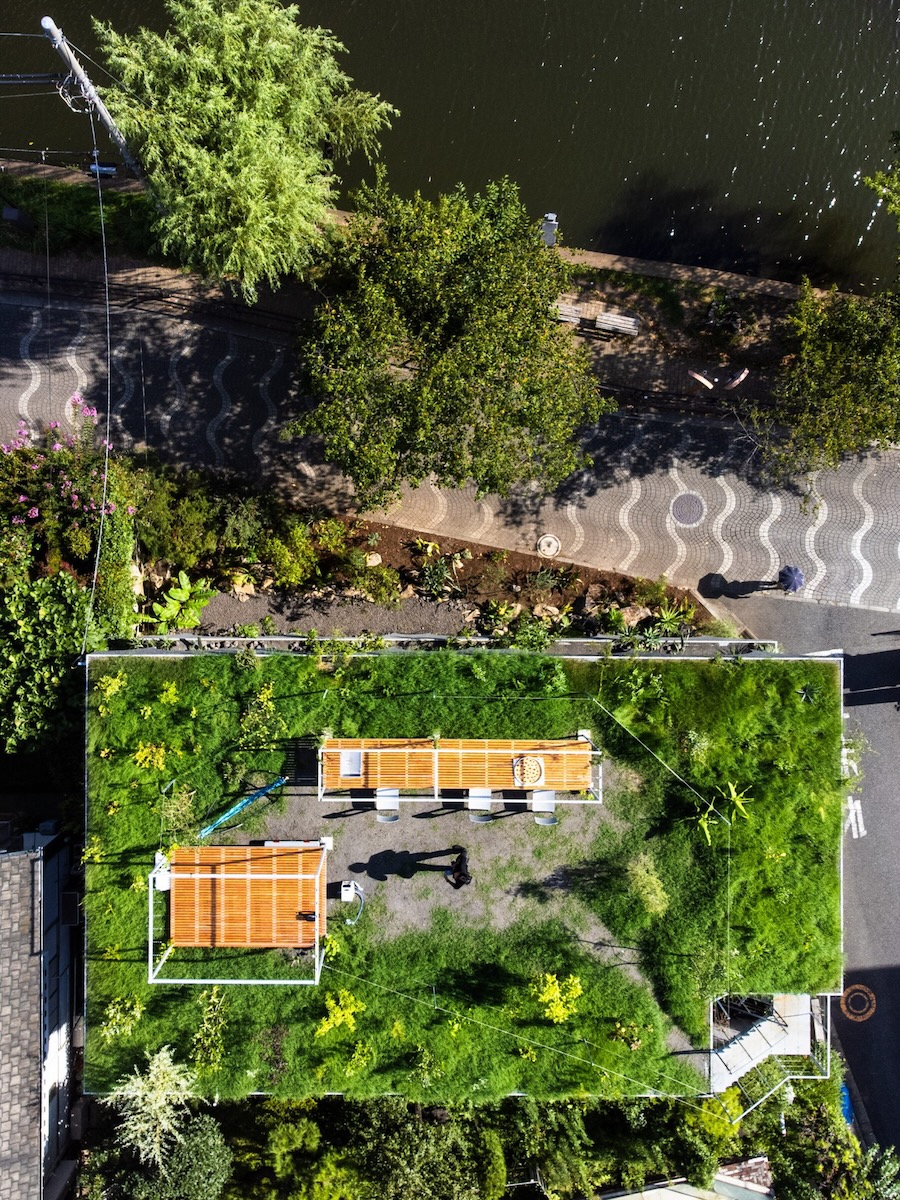
Among his most striking works is Tsuruoka House (2021) in Tokyo. The structure functions as both the architects own home and studio, and is defined by a series of interconnected concrete vaults that cradle deep beds of soil above the living spaces. The home, explains Takeda, was inspired by a landmark 2020 study published in Nature explaining that the mass of human-made objects had now exceeded that of all living biomass. Tusuroka House is the architect’s response to this alarming statistic.
Over time, birds have carried seeds onto the roof, allowing grasses and native plants to colonize the structure naturally. Instead of maintaining a perfectly curated green roof, Takeda welcomes this spontaneous growth, allowing the architecture to mature as a living ecosystem.


An urban oasis beneath the trains
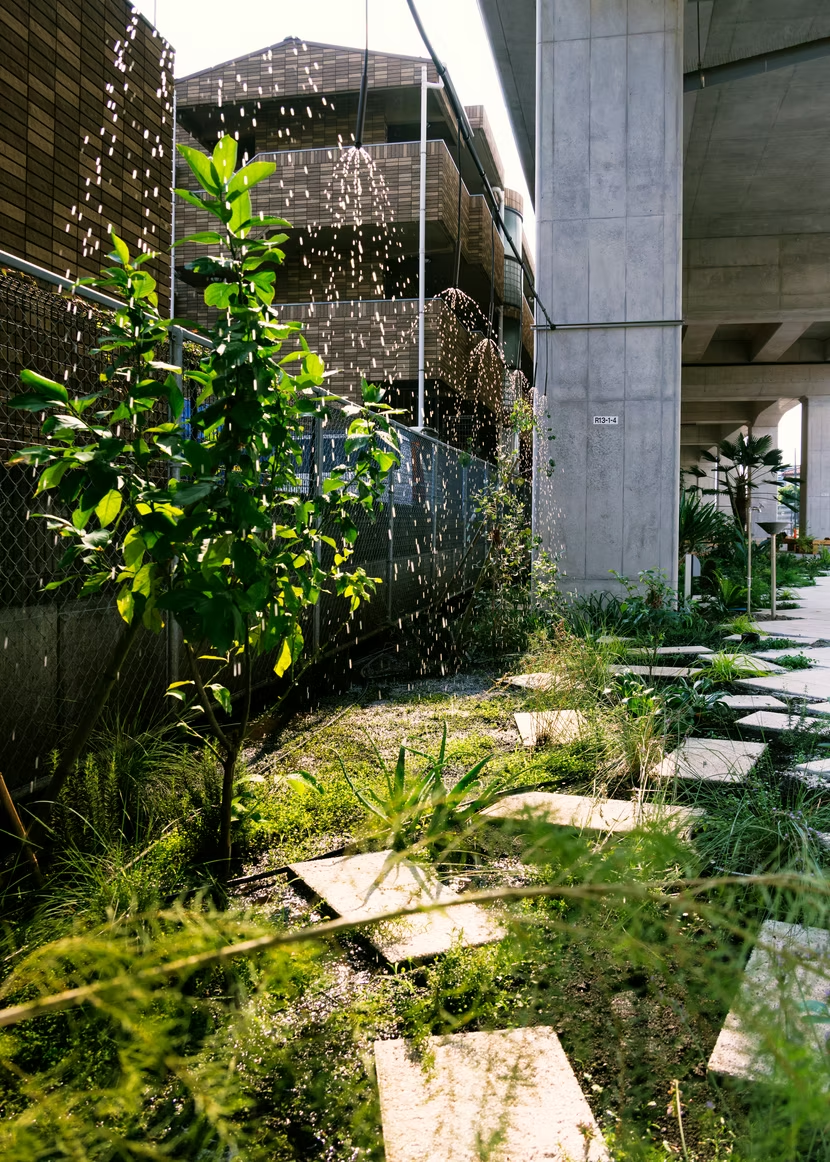
Can a garden exist beneath a viaduct? The answer, according to Kiyo Takeda, is an unequivocal yes. In fact, they may even be ideal for gardens. Over the last two decades, much of Tokyo’s urban railways were elevated high above ground to reduce street accidents and congestion. In 2024, Takeda completed Play! Koukashita, transforming an overlooked stretch beneath a railway viaduct in Tokyo’s Nerima Ward into a surprising urban oasis.
“Because the viaduct rises well above the surrounding houses, the area below is surprisingly filled with light and enjoys excellent airflow,” explained the architect. “The long, continuous form of the viaduct also acts as a vessel that collects and channels the city’s rainwater.”
The project serves as proof-of-concept of Takeda’s broader architectural philosophy of working with existing environments rather than against them. The space was able to exist only because the city’s concrete structures that came before it.



A hotel inspired by urban gardening
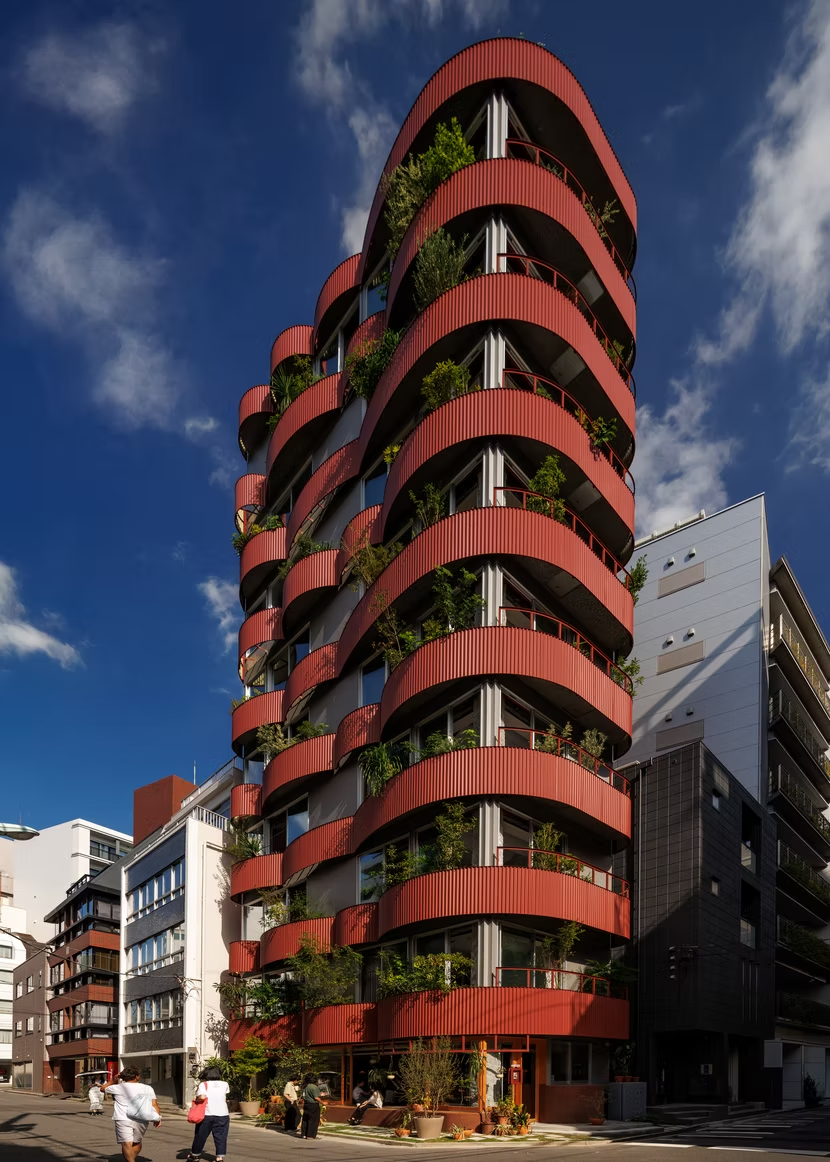
Tucked away on a quiet backstreet in Tokyo’s historic Ningyocho district is one of Takada’s most-recent works. And it borrows, both literally and figuratively, from its neighborhood’s distinct culture of “back-alley gardening.” Ningyocho has a local tradition of “kabu-wake,” the sharing of plant cuttings. And over decades, hundreds of species of plants have promulgated across the neighborhood in the form of terracotta pots that line the sidewalk.
SOIL Nihonbashi Hotel is a narrow 14-room boutique hotel that opened in 2025. The hotel’s distinctive, undulating facade echoes the ubiquitous terracotta planters and clay-rich soil found throughout the neighborhood. Staying true to tradition, neighbors even donated numerous cuttings to the hotel, thereby creating a living, breathing connection between the hotel and its surroundings.
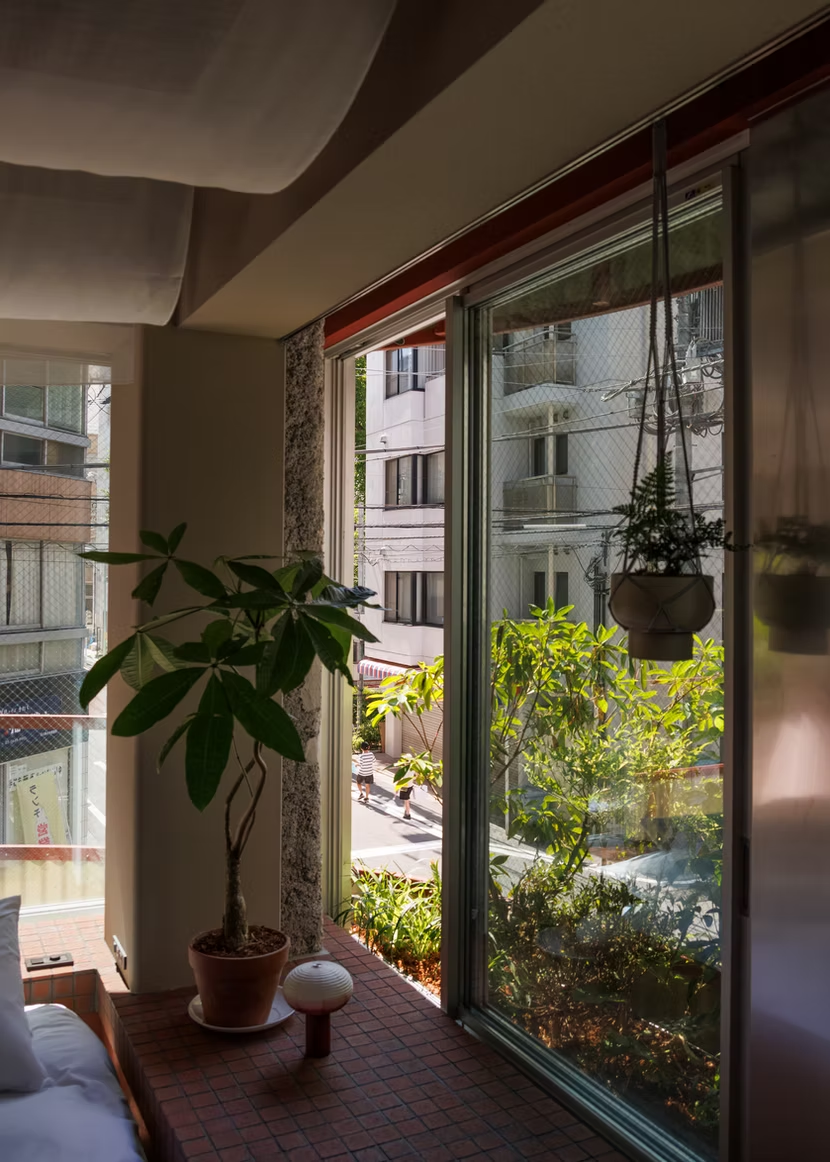


Natural materials carry the theme indoors as well. Stone door handles collected from Itoigawa, richly grained wood finishes, and handcrafted planters made from recycled ceramics all reinforce the feeling that nature is woven into every part of the guest experience.
But SOIL extends beyond the building itself. Guests are encouraged to explore the surrounding neighborhood through a network of affiliated businesses, including Pizza Tane, a pizzeria serving naturally fermented sourdough pizzas made with a starter cultivated over three years at the nearby Parklet Bakery. Wine can be selected from the neighborhood bottle shop, and coworking spaces and community events are integrated into the stay.


In an era increasingly defined by biodiversity loss, Takeda’s buildings offer a compelling alternative to architecture as static object. Instead, they are designed as living frameworks: places where humans, plants, animals, and time itself shape the finished work together. The result is architecture that doesn’t simply sit within nature, but continues to grow with it.











Leave a Reply