Page 145 of 409

Music Monday: Okazaki Taiiku

okazaki-taiiku

Okazaki Taiiku is not your typical musician. At age 26, he’s chubby with unkempt hair and stubble. His typical uniform is a hoodie and baseball cap, which rests haphazardly on his head. He looks more like he’s been lying around playing video games, rather than making what he calls Basin Techno. It’s an odd look that is a stark contrast with his stage name Taiiku, meaning physical education (his real name is Akitoshi Oka). But looks can deceiving and perhaps that is part of the allure to Taiiku, who mixes humor with addictive beats and melodies while jumping around in his music videos out of breath, looking like he may collapse.

Continue reading

Kintsugi: the Japanese art of repairing broken ceramics

Kunio Nakamura 4

photo by Kunio Nakamura

To find beauty in broken things is the spirit of wabi sabi, at least according to Muneaki Shimode, a young artisan from Kyoto who practices kintsugi. The word is written as 金継ぎwith kin meaning gold while tsugi means to connect, as in connect to the word or connect to generations. It’s the Japanese art of repairing broken ceramics using a special lacquer mixed with gold, silver or platinum. The 400-500 year-old technique seeks to fix broken things not by disguising the break but, instead, accentuating it.

Continue reading

An Artist Duo That Turns Japanese Puns into Visual Works of Art

DAJAART dajare art (header)

can you guess which common dajare are represented in these photographs?

Dajare is a form of Japanese wordplay, much like a pun, that relies on similar-sounding words to form the joke. And in Japan, these puns are literally everywhere. They’re in dates, they’re in advertising, they’re in business. Japan even built their famous Tokyo Sky Tree to a height of 634 m (6-3-4 can be pronounced “musashi,” which is the old name for the area the tower stands) just so that the tower could be more pun-y.

Now, an artist duo are doing the impossible: they’re translating dajare into visual works of art.

Continue reading

A Creative Music Video Vertically Designed For Your Smartphone

lyrical-school-gif

Stop. Before you read any further, are you reading this on your smartphone? If not, it’s highly recommended that you do. Trust us – it’s worth it. Lyrical School is a Japanese girl group composed of 6 members. Although they’ve been around for a few years, they’ve never really made it big. But that could all change with their latest music video RUN and RUN, which definitely goes down as one of the most creative we’ve seen.

Continue reading

This Minimal Tube Has Everything You Need to Survive a Natural Disaster

nendo-minimaid-disaster-kit (1)

If there’s any country that knows a thing or two about surviving natural disasters, it’s Japan. The country has recovered from numerous earthquakes and tsunamis and the recent series of earthquakes in Kyushu have once again highlighted the importance of emergency preparedness. Late last year design firm Nendo partnered with hardware manufacturer Sugita Ace to create this versatile emergency preparedness kit that’s smaller than a standard umbrella.

Continue reading

Walk Through the World of Manga Artist Naoki Urasawa

ursw_003_daici_ano-600x400

all photos by Daici Ano

Naoki Urasawa is somewhat of a phenomenon. Throughout his career – he’s still 56, I might add – Urasawa has sold over 120 million manga and his works, which include Master Keaton, Monster and 20th Century Boys, have been adapted into anime and movies. His works are known for their dense, multi-layered narratives that often involve thrilling suspense and mystery. Earlier this year the Setagaya Literary Museum hosted a two and a half-month long exhibition on Urasawa titled “A Life in Drawings.” Although the exhibition ended in March, images are now available for those who didn’t get a change to see how Urasawa breathes life into his many works.

Continue reading

New FabCafe Hida Opens in a 100-Year Old Renovated Minka

fabcafe-hida-new0

FabCafe, the digital fabrication space that offers visitors the use of laser cutters and 3D scanner along with their coffee, has opened a new cafe in Hida  (Gifu prefecture). The new space, located over 300 km west of the original Shibuya location, is opening its doors April 16, 2016 in a 100-year-old renovated Japanese townhouse known as a minka.

Continue reading

Damaged Kumamoto Castle Actually Withstood the Earthquake Just as Ancient Architects Intended

kumamoto castle

Kumamoto Castle (photo by spoon & tamago, taken in 2015)

Editor’s Note: in the days since this article was written, numerous earthquakes and aftershocks have struck, causing additional damage to the castle, and Kyushu as a whole. Earthquake resistant architecture obviously isn’t as simple as ceramic roof tiles being shaken to the ground. This article should be construed as highlighting an ancient method that architects tested in an earthquake-prone nation, rather than an modern usage of earthquake-resistant technology.

A powerful earthquake (M 6.5) rocked southern Japan on Thursday, with an even larger tremor (M 7.3) hitting on Friday. As of now the death toll is in the single digits with roughly 1000 reported injuries. Those numbers will likely rise but as of now it seems that the fluid situation could have been a lot worse. One of the more visually shocking images is the damaged Kumamoto-jo, a majestic castle dating back to 1467 and is a powerful symbol of  the Kumamoto region.

Continue reading

The Molecular Structure of Glass Magnified and Recreated with 5000 Pieces of Glass

AGC_Amorphous 0006

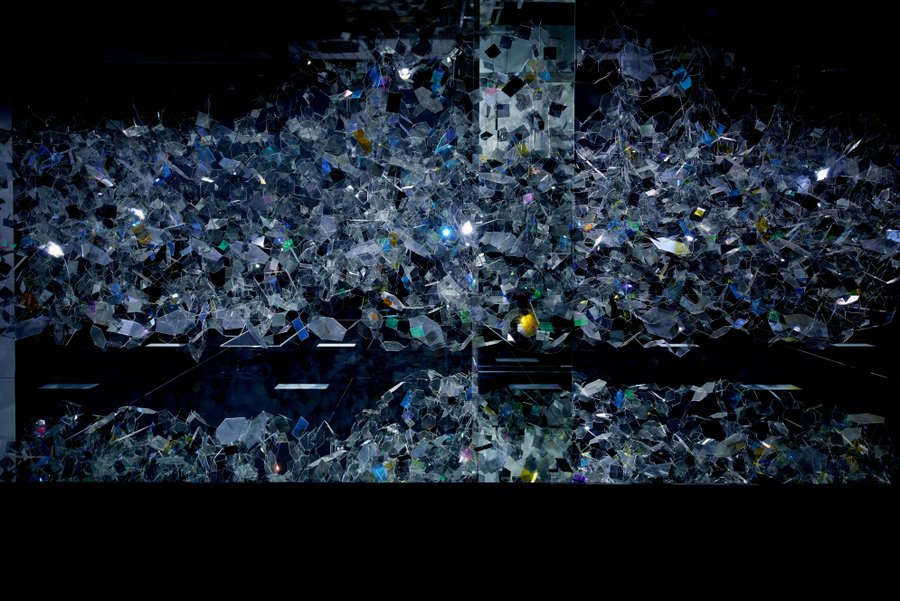
Perhaps you learned in physics class that glass is a material composed primarily of silicon and oxygen or, if you want to get nerdy, SiO2. But what does that really mean? And, more importantly, what would it look like? Using 5000 pieces of thin glass suspended in mid-air, a Japanese designer has recreated the non-crystalline (amorphous) molecular structure of glass in a model one billion times its actual size.

Continue reading

Origami-Inspired Mural of a Haniwa Doll by Street Artist DAAS

DAAS-Takatsuki-mural 1

It’s rare to find commissioned street art in Japan, perhaps because of strict law enforcement towards anything construed as graffiti, but also because of a general avoidance of public displays of expression. But there are exceptions, and it’s certainly nice to see an exception so colorful. In Takatsuki City, Osaka a mural recently popped up depicting a vibrant Haniwa doll, a horse and a traditional home.

Continue reading

« Older posts Newer posts »

© 2026 Spoon & Tamago

Up ↑

Design by Bento Graphics