Page 253 of 406

Tsuyoshi Ozawa’s Vegetable Weapons

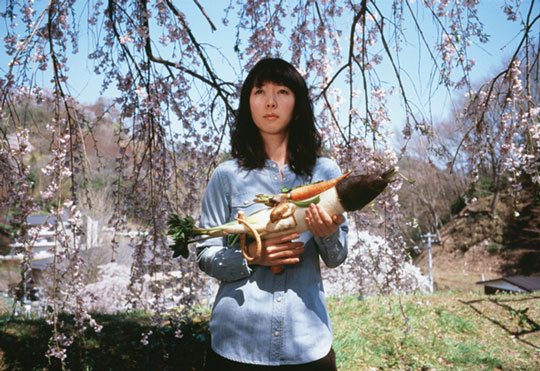
Vegetable Weapon-Nishime (Simmered Vegetables) / Fukushima, 2011

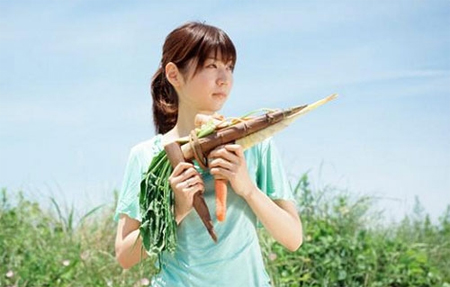
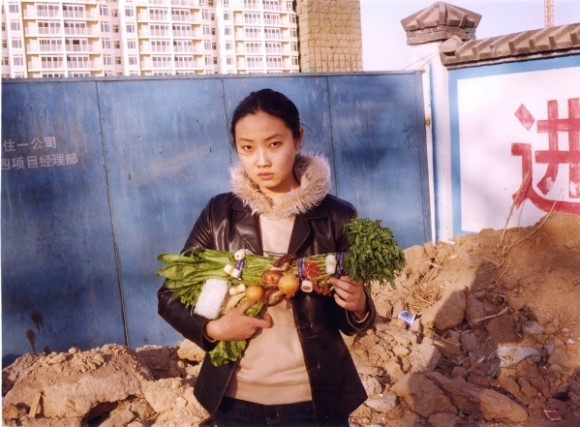
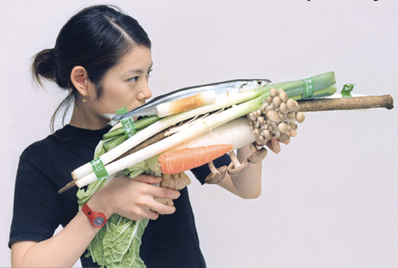
Japanese photographer Tsuyoshi Ozawa’s Vegetable Weapons series began in 2001. Since then, he has traveled around the world taking photographs of young women holding “weapons” fashioned from the ingredients needed to make an indigenous hot-pot dish. His art concludes in him making an actual hot-pot and sharing a meal. His series, which poke fun at the stupidity of war and violence, will be on display as part of a group show at Misa Shin Gallery. Noteworthy will be a recent addition to the series – a work photographed in Fukushima right after the earthquake and the nuclear power plant accident in March 2011.

Chikuzenni (Simmered vegetables with chicken) / Kyoto, 2008

Today everything exists to end in a photograph.” – Susan Sontag

Borrowing from the title of Susan Sontag’s classic 1977 book, the group exhibition “ON Photography” runs through November 2, 2012

 Mutton hot pot / Beijing, 2002

Saury fish ball hot pot / Tokyo, 2001

Vegetable Weapon-Crawfish Etouffee / New Orleans, 2011

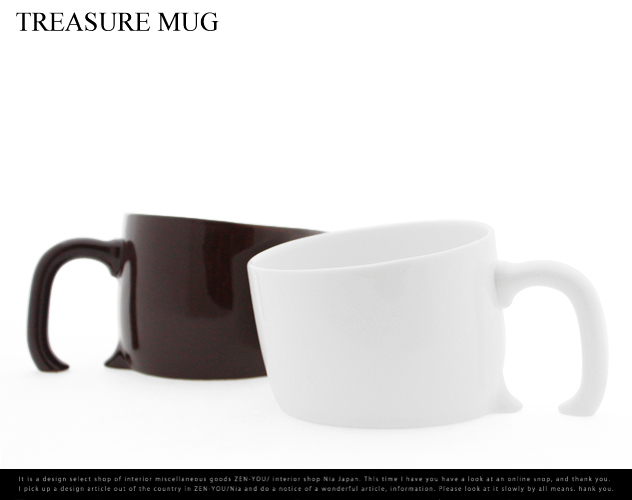
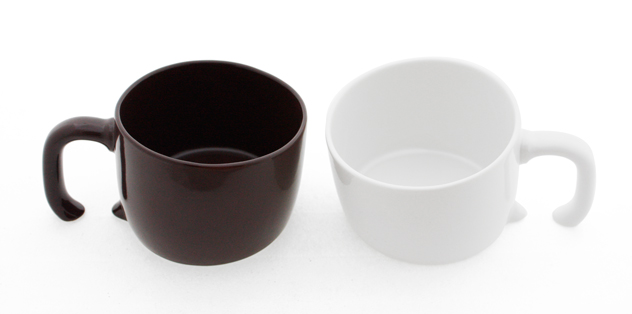
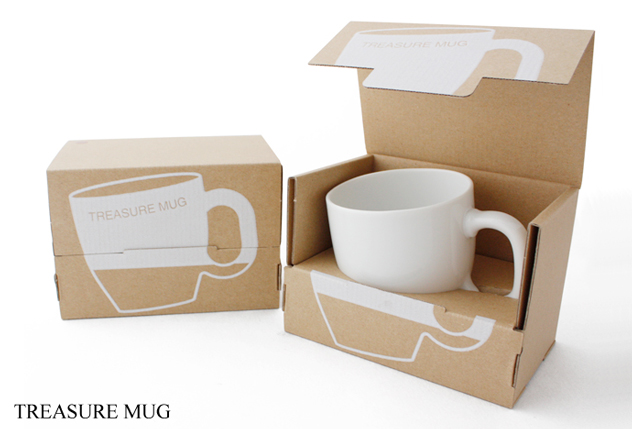
treasure mug appears to sink into your table

The Treasure Mug takes its name from an illusion it creates, appearing as if it’s a treasure chest emerging from sand. The trick is pretty simple: a slanted base and trimmed handle creates, what I think, looks more like a mug sinking into a table. Either way, it’s sure to make your morning coffee a bit more interesting!

You can purchase it directly from plywood (1,260 yen), an Japanese interior design shop. If you live overseas, your best bet is Amazon JP, since they ship overseas.

(PS: I love the very serious Japanese disclaimer: “Please note that when placed on surface, this cup will be slanted. This design is intentional and is not a defect.”)

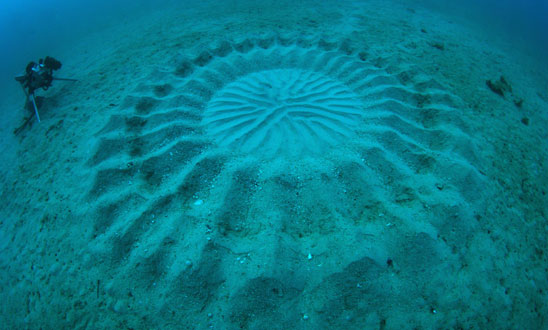
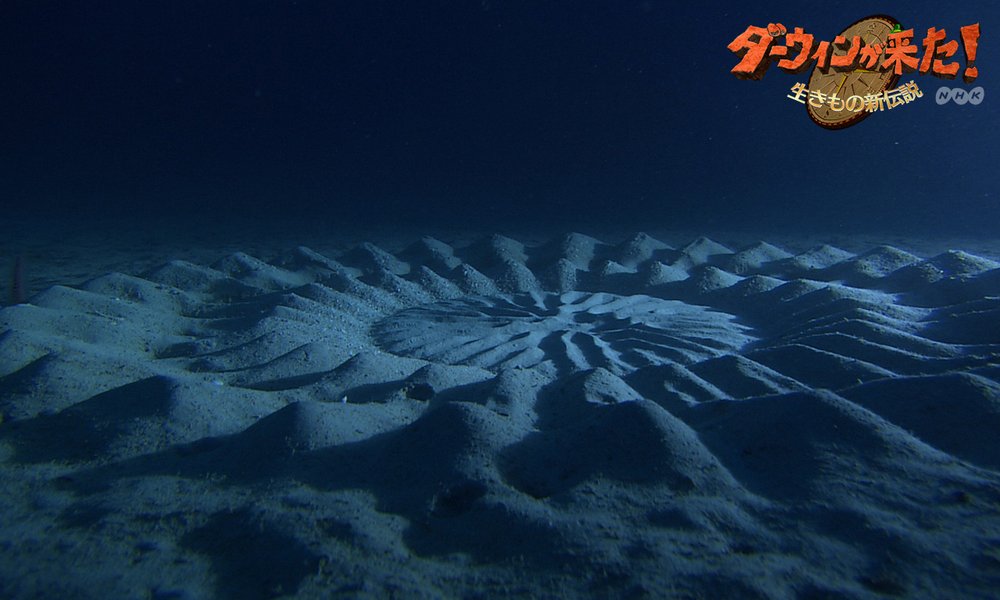
The Deep Sea Mystery Circle – a love story

puffer fish crop circle

images courtesy Yoji Ookata and NHK

Introduced to life under the sea in high school through snorkeling, Yoji Ookata obtained his scuba license at the age of 21. At the same time, he went out and bought a brand new NIKONOS, a 35mm film camera specifically designed for underwater photography. He devoted all his spare time – aside from his day job – to perfecting his art of underwater photography. Then, at age 39, he finally made the transition. He quit his office job and became a freelance underwater photographer.
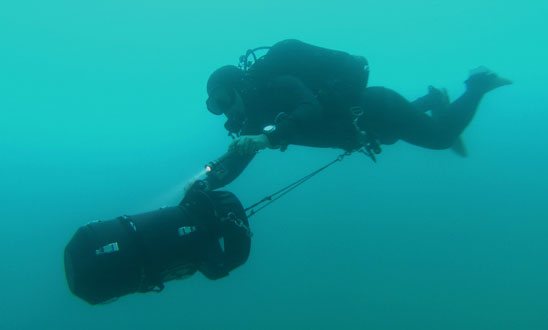
yoji ookata puffer fish

But even for a man who spent the last 50 years immersed in the underwater world of sea life, the ocean proved infinitely mysterious. While diving in the semi-tropical region of Amami Oshima, roughly 80 ft below sea level, Ookata spotted something he had never seen. And as it turned out, no one else had seen it before either.
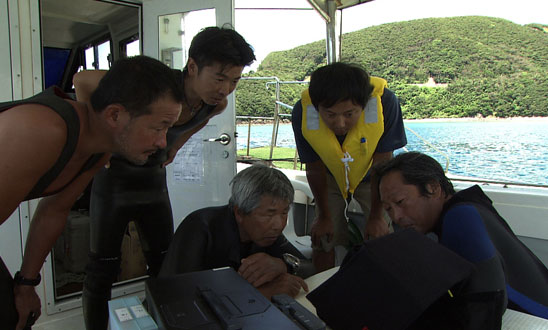
amami oshima puffer fish

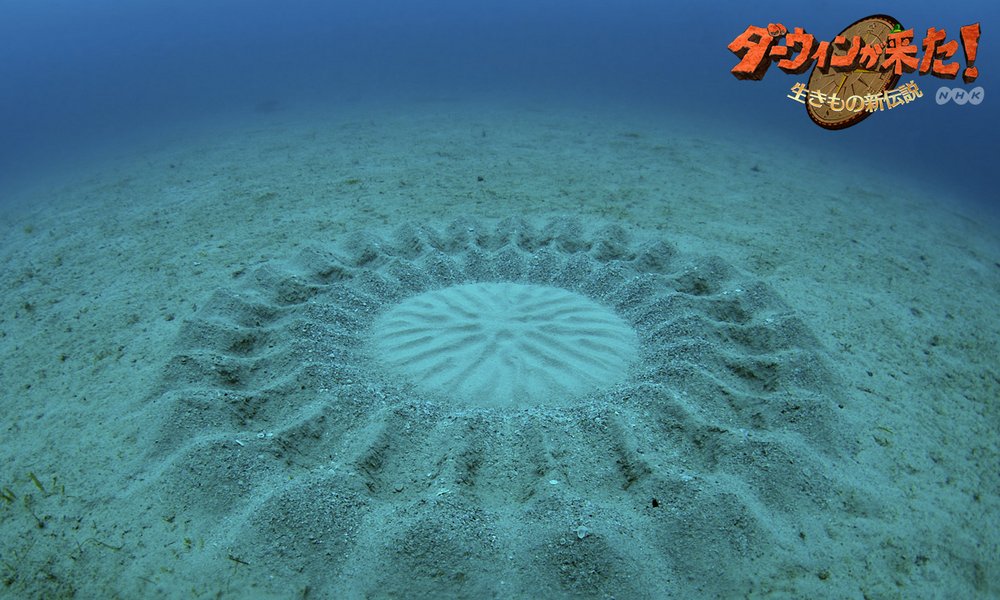
On the seabed a geometric, circular structure measuring roughly 6.5 ft in diameter had been precisely carved from sand. It consisted of multiple ridges, symmetrically jutting out from the center, and appeared to be the work of an underwater artist, carefully working with tools. For its resemblance to crop circles, Ookata dubbed his new finding a “mystery circle,” and enlisted some colleagues at NHK to help him investigate. In a television episode that aired last week titled “The Discovery of a Century: Deep Sea Mystery Circle,” the television crew revealed their findings and the unknown artist was unmasked.
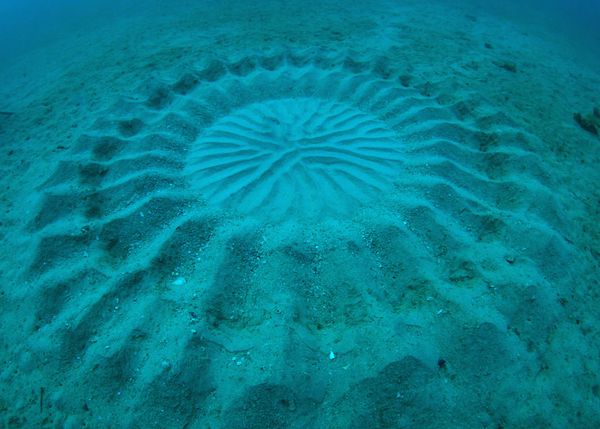
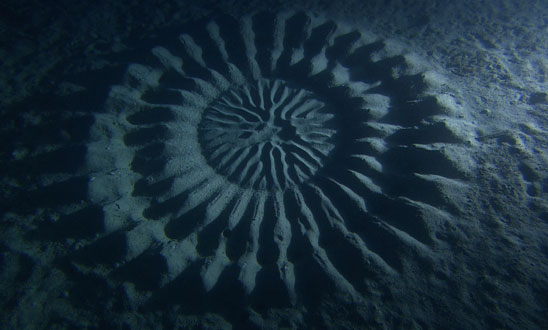
puffer fish crop circle

puffer fish crop circle

puffer fish crop circles

Underwater cameras showed that the artist was a small puffer fish who, using only his flapping fin, tirelessly worked day and night to carve the circular ridges. The unlikely artist – best known in Japan as a delicacy, albeit a potentially poisonous one – even takes small shells, cracks them, and lines the inner grooves of his sculpture as if decorating his piece. Further observation revealed that this “mysterious circle” was not just there to make the ocean floor look pretty. Attracted by the grooves and ridges, female puffer fish would find their way along the dark seabed to the male puffer fish where they would mate and lay eggs in the center of the circle. In fact, the scientists observed that the more ridges the circle contained, the more likely it was that the female would mate with the male. The little sea shells weren’t just in vain either. The observers believe that they serve as vital nutrients to the eggs as they hatch, and to the newborns.
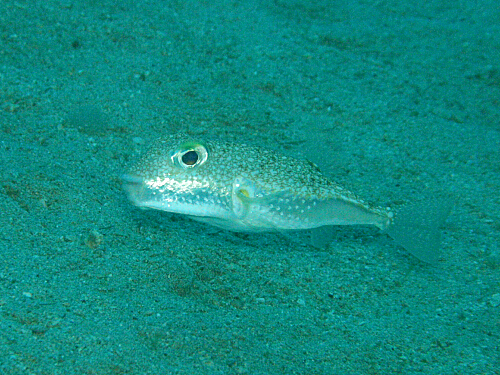
puffer fish

the artist at work

puffer fish crop circle

What was fascinating was that the fish’s sculpture played another role. Through experiments back at their lab, the scientists showed that the grooves and ridges of the sculpture helped neutralize currents, protecting the eggs from being tossed around and potentially exposing them to predators.

It was a true story of love, craftsmanship and the desire to pass on descendants.
puffer fish crop circle

click images to enlarge

puffer fish crop circle

UPDATE [Aug 26, 2013]

Video footage of the little artist at work recently surfaced. It was uploaded to YouTube by MarineStation Amami, a hotel and dive center that assisted Yoji Okata and NHK in producing the video segment that aired last year. Of note, watch at around 1:20 when the fish takes a small shell in his mouth and plants it in the sculpture. Scientists believe that the shells are filled with vital nutrients and this is the soon-to-be-father’s way of preparing nourishment for the babies.




Japanese Movable Paper Robot

images courtesy kikousya | click to enlarge
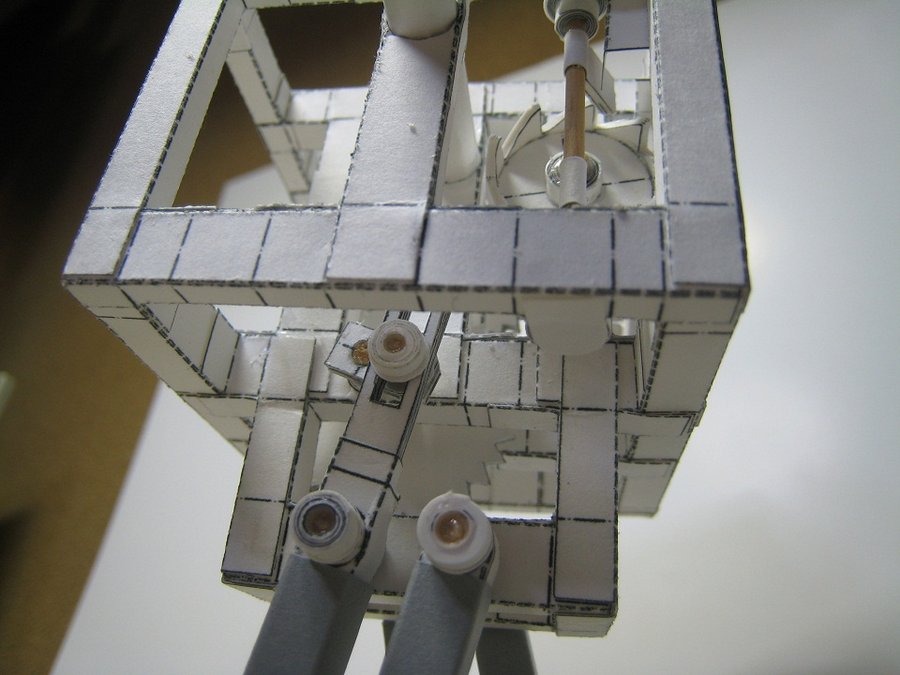
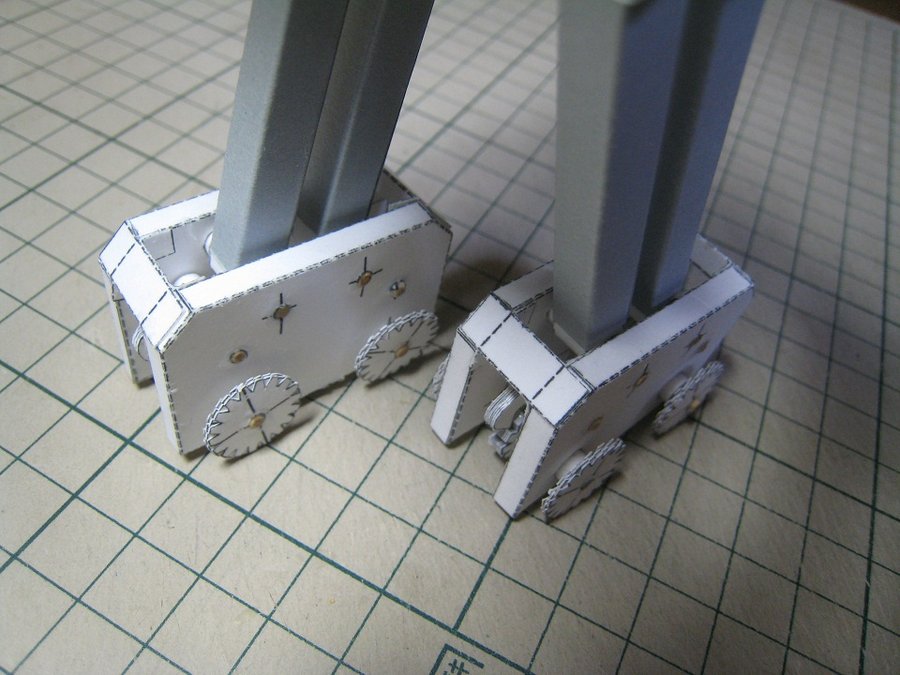
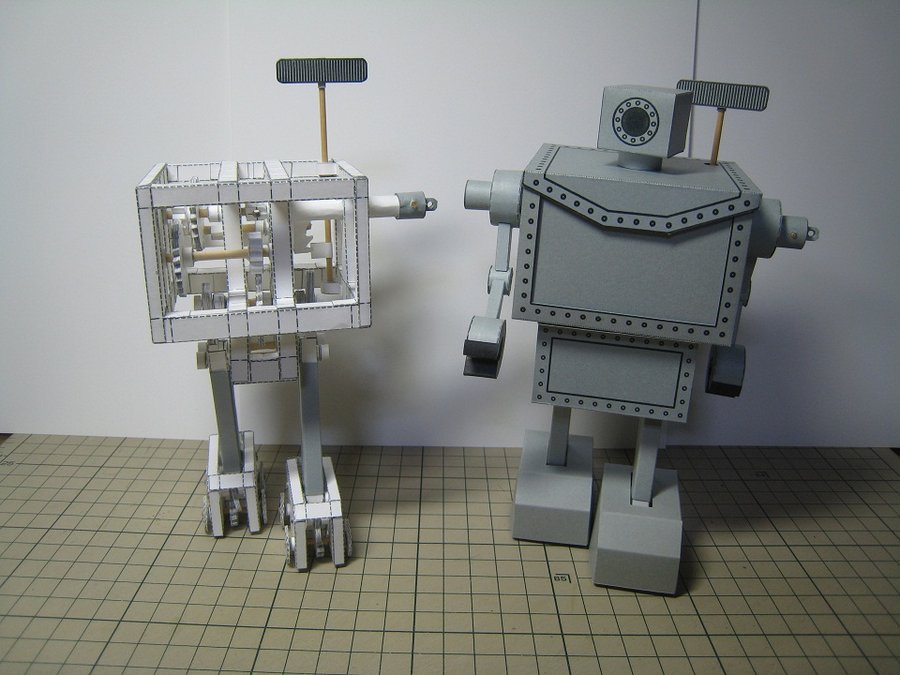
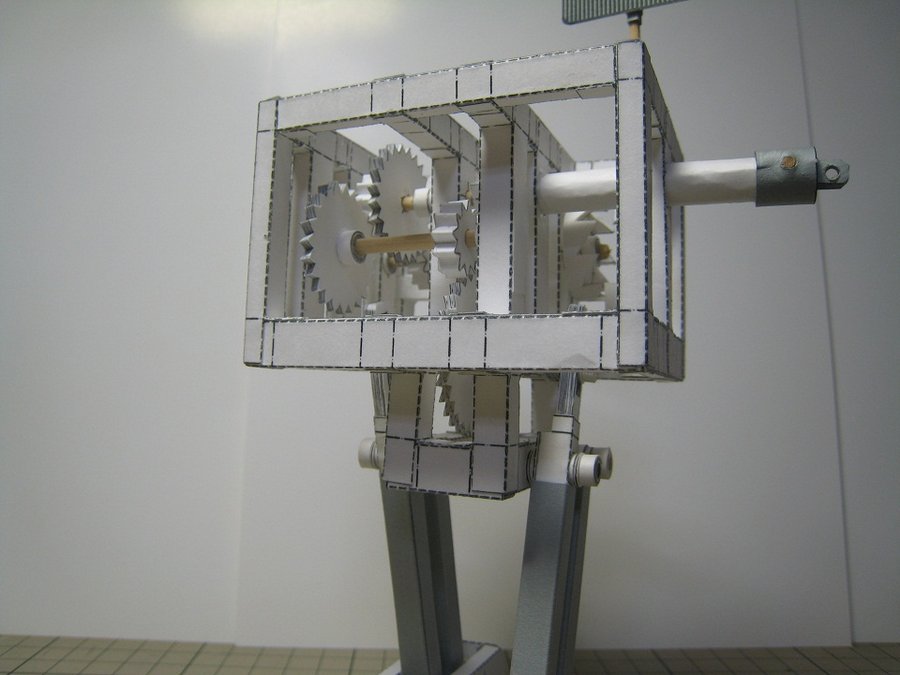
Inspired by the 400-year old “Chakumi-Ningyo” (茶運人形) – the coil spring-powered tea serving robots that move when a cup of tea is placed on their tray – a Japanese man decided to see if he could do something similar, only with paper. Choosing to remain anonymous, the man (yes I’m being stereotypical by assuming he’s a man) writes about his trials and tribulations in devising his paper robot. After many prototypes he finally completed PR-III, a movable robot that, other than a rubber band and some bamboo pivots, is made entirely from paper. Impressive!

A time-lapse of the robot coming together, piece by piece, is captured in the video below. If you’re short on time, cut to 3:15 when the robot starts moving.

Confident in his new contraption, he’s put all the diagrams and instructions on a CD-Rom and is selling it for 3000 yen. But you’ll have to email him to make arrangements for payment and delivery. And even if you do, you’ll have to navigate a complete set of self-assembly instructions in Japanese. If you really want to take on the labor of love, try the “Chakumi-Ningyo,” which he’s put online for anyone to download for free.

As a youtube commenter pointed out, on a scale of one to ten, the difficulty level is “Asian.”

Via @tinybop

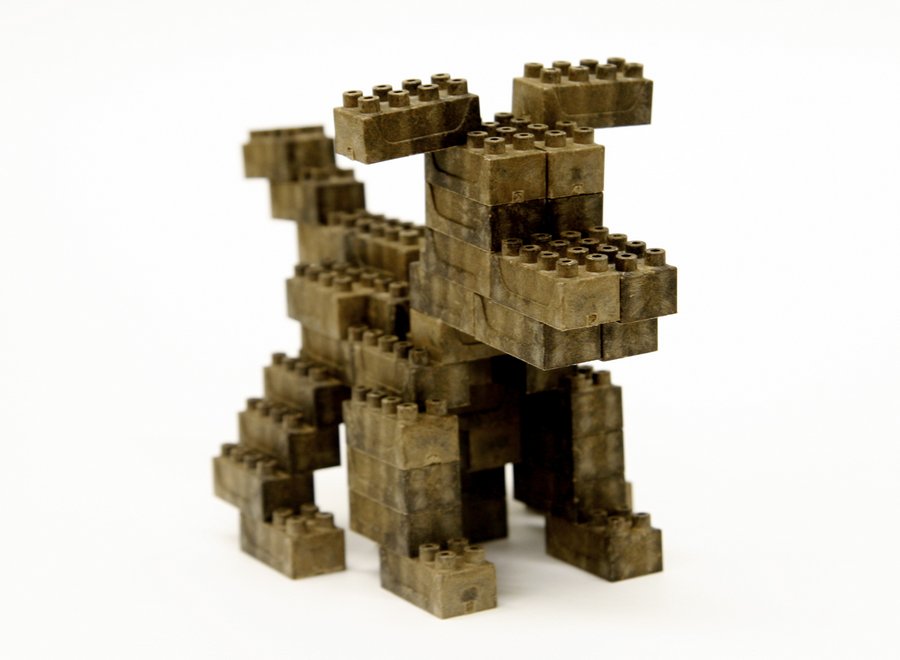
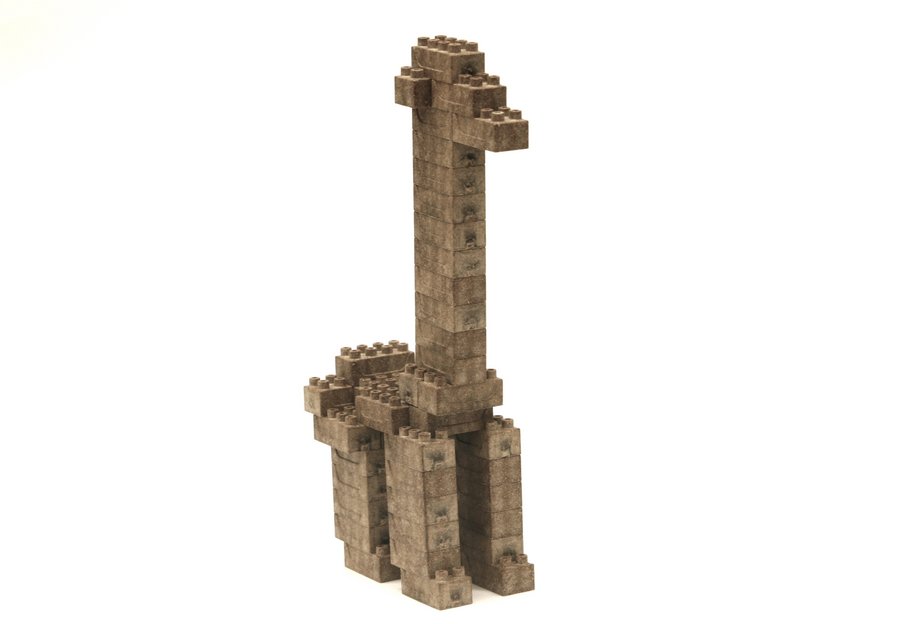
flash sale – eco-friendly earth blocks

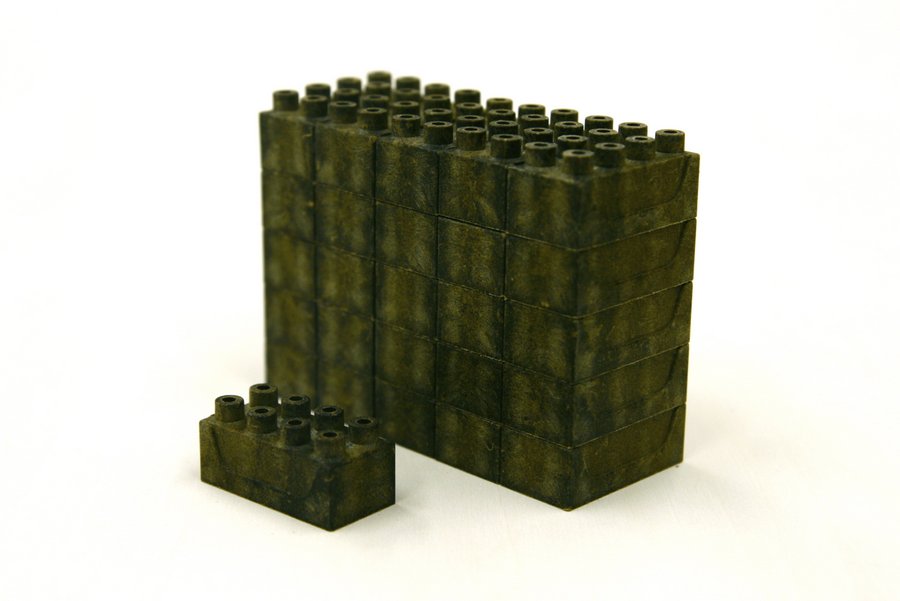
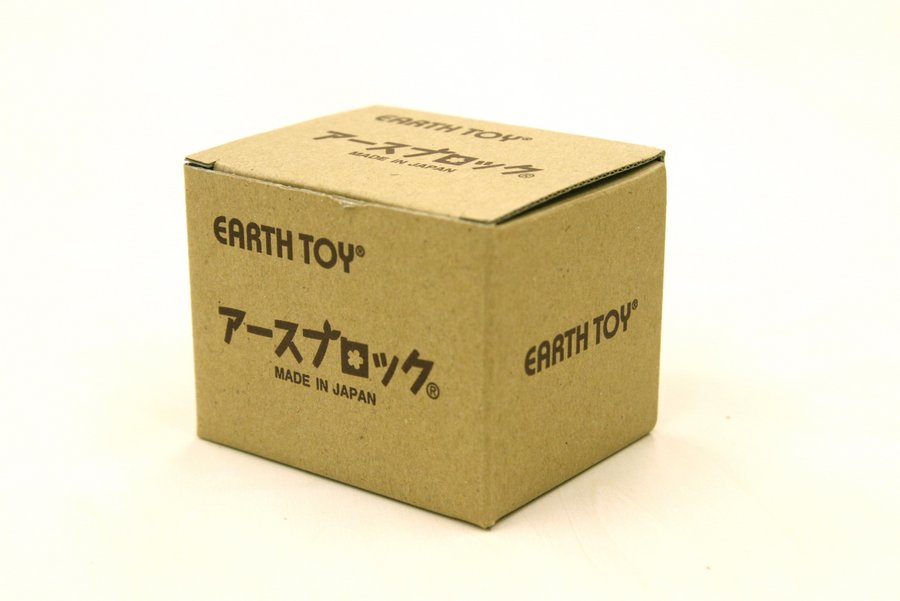
Earth Blocks are  building blocks made from a composite of recycled materials – coffee beans, green tea leaves, sawdust and tree bark. What’s amazing is that they’re made from so much biomass that they don’t smell like plastic – they smell like coffee, or the respective material they’re made from. Guaranteed hours of creative building and sniffing!


Dimensions: 1 1/4″ x 5/8″ x 5/8″ (per piece. each set contains 50 pieces)
Price: $30
Made in Japan.
Flash sale closes 09.23.2012.
Product ships 09.30.2012.

This flash sale is now closed.

Rooms that follow the landscape by On Design

All photos by Koichi Torimura |click to enlarge

Summer is coming to an end, but I can still lust over vacation homes. Just last month Japanese architecture studio On Design completed a brand new vacation home in the picturesque town of Karuizawa. Favored for its proximity (and relative coolness) to Tokyo, the town is a common destination for Tokyoites to escape the summer heat.

There, up on a small hill, the architects constructed a weekend getaway that emphasizes one thing – the scenery. But don’t call it a home. “Rooms that follow the landscape” are just that – a series of rooms that are situated to capture different moments as the sun moves across the sky. Site-specific irregularities like inclines, bumpiness and angles – elements that are usually avoided or, in some cases, smoothed out – all work together with the rooms to create a space that literally follows the landscape.

Hiroshi Fuji creates installation from 50,000 recycled toys

hiroshi fuji kaeru toy installation (1)

photo by Kim Kyung-Hoon for Reuters | click to enlarge

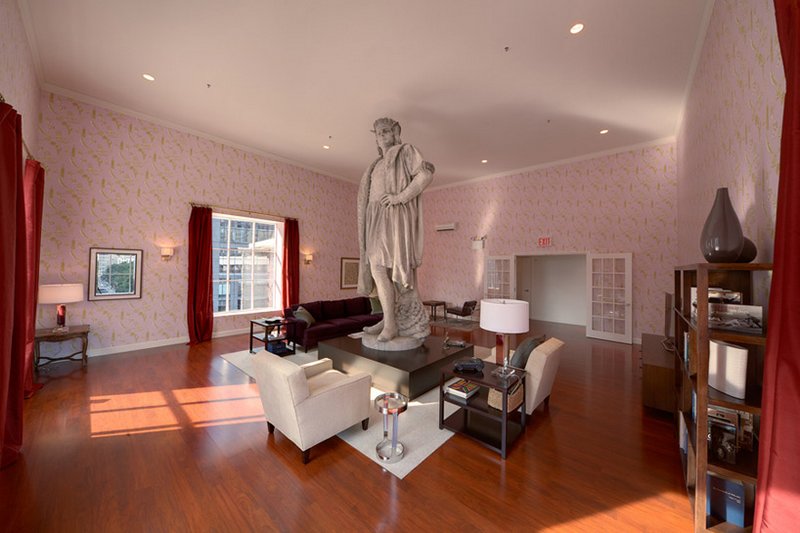
Serial recycling artist Hiroshi Fuji brings his eco-friendly art to 3331 Arts Chiyoda where he created a large-scale installation using over 50,000 old toys leftover from his toy exchange program. Based on specifications like size and color, Fuji created dinosaurs, flying birds, mountains and walk-ways, filling the entire main gallery with colorful remnants of our childhood.

But the exhibition, which just closed last weekend, wasn’t all fun and games. Despite being made from colorful toys, the installation, at its core, was a heaping mound of discarded trash. It was a poignant reminder of the disposable nature of modern toys and how quickly we outgrow and discard them.

hiroshi fuji kaeru toy installation (8)

photo by Masanori Ikeda | click to enlarge
hiroshi fuji kaeru toy installation (7)

Hiroshi Fuji is well known for his sculptural works made from recycled materials. In 2009 he floated a gigantic boat, made from scrap PET bottles, down a river. And in 2008 he created a pretty amazing “forest” with hanging sculptures. His long-term project is called kaekko, an exchange system for old toys that Fuji started 13 years ago.

hiroshi fuji kaeru toy installation (2)

all photos below by Kim Kyung-Hoon for Reuters

hiroshi fuji kaeru toy installation (3) hiroshi fuji kaeru toy installation (4) hiroshi fuji kaeru toy installation (5) hiroshi fuji kaeru toy installation (6)


Source: collabcubed | 3331 Arts Chiyoda

Art show preview: Mr. at Lehmann Maupin Gallery

all images © mr./kaikai kiki co., ltd. | courtesy lehmann maupin gallery | click to enlarge
Fine art or an unhealthy obsession with prepubescent girls?

Fine art or an unhealthy obsession with prepubescent girls? The question will undoubtedly be on many people’s minds when Japanese artist Mr. unveils a new body of work at Lehmann Maupin Gallery in New York tomorrow. One of Takashi Murakami’s more successful protégés, the 42-year old artist first exhibited at Lehmann Maupin in 2007, where his paintings of girls “lifting their skirts, flashing bits of underwear and fearfully gazing up at a naked man’s crotch” were the center of much attention. But this time around, the self-proclaimed otaku with an unapologetic Lolita complex wants to be taken more seriously as he imbeds his personal fantasy-laden work with deeper, darker themes relating to the catastrophic events of March 11, 2011.

production sketch for installation

“the Japanese people rose in a unified effort to recover from the devastation of the loss of World War II,” says the artist in a press release. “But along with the recent economic stagnation, the earthquakes in Eastern Japan, and the after effects of the nuclear disaster, a collective depression from an inability to vent their frustrations continues to accumulate within their society.”

The centerpiece of the show plans to be a chaotic installation that mimics a typical room of a single otaku male, immersed in his own delusional fantasy about young girls. Viewers are invited into this unsettling yet seductive space where they are given glimpses into the psychological state of otaku, and hence Japan. Composed of garbage, gadgets, magazines and everyday things, the installation is supposed to remind us of the debris that blanketed Tohoku in the aftermath of the tsunami.

Is Mr. all grown up? Perhaps. The title of his show “Metamorphosis” would seem to indicate some form of development. Until you realize it’s actually “Metamorphosis: Give Me Your Wings,” a forceful turning-of-the-tables that at once removes any realistic responsibility from the artist. And that makes me happy. I would hate to see an artist like Mr. grow up.

Design housing after Fukushima – “Home for all”

image courtesy Domus
Japanese designers have created a sensation at the Venice Biennale 2012, taking home the Golden Lion for Best national participation. And they deserve it. Once again their work shows how something completely knew can arise from dust and ashes.
After the Fukushima disaster a collective of architects – Riken Yamamoto, Hiroshi Naito, Kengo Kuma, Kazuyo Sejima and Tokyo Ito, gathered after they noticed a surprising yet understandable trend: natives were not leaving their land in spite of a distressed landscape. Instead of waiting around for the State’s reconstruction policy to take effect, they decided to give these rooted people hope – and a roof to share their hope – for the future.

“Home for all” (Minna no Ie) was inaugurated in October 2011. As this initiative was a success, the architects embarked on a second iteration, in which they appealled to volunteers to send in ideas. The full letter can be found here (PDF) but below is an excerpt:

With this opportunity, we would like to call for architects, architectural students and children in the world to join us in drawing up images of the “Home-for-All”… This is not a competition but there might be a possibility to build some of your ideas. If you are able to submit a work, we would be very grateful to receive it.

The models exhibited in the Japanese pavilion are answers to the this appeal. In this project I am particularly amazed by the human side of the work. Beyond the architect’s collaboration, it is also a collaboration directly with the inhabitants. They are at the core of these temporary homes, expressing their needs, their dreams, their desire. As Toyo Ito said, “architecture as a place to make people gather, a place that everybody can use.”

images courtesy David Basulto, ArchDaily

For further reading, check out this great interview of Toyo Ito on curating the exhibition in Venice.


A tree house for 1 person and 78 birds

photos by Masaya Yoshimura and Daici Ano

Design firm Nendo has created a massive tree house dubbed “bird apartment,” in which visitors to the natural sanctuary can climb in and observe 78 mini-birdhouses through peep-holes. From the front, the structure resembles an urban apartment complex, except it’s entirely out of place perched high in a tree. A slightly precarious-looking ladder connects the back of it to the ground, allowing one visitor at a time to climb up and observe each apartment unit through tiny holes.

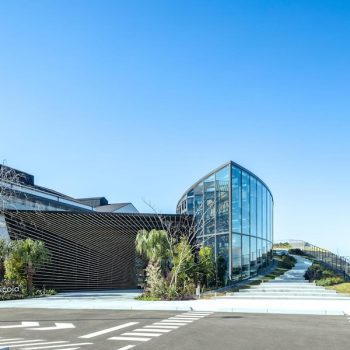
Bird Apartment is located in the Ando Momofuku Center, a nature conservatory named after Mr. Cup Noodle himself. The center certainly has a taste for design as its main facility is a stunning structure designed by Kengo Kuma.

Check out all of our articles on Nendo, one of the big hitters of the Japanese design scene.

Source: press release


« Older posts Newer posts »

© 2026 Spoon & Tamago

Up ↑

Design by Bento Graphics